Hospitality Newsletter
Latest trends of the Greek hospitality sector
Explore Newsletters
The GBR Consulting Hospitality Newsletters provide a snapshot of the performance and outlook of the Greek hotel industry, within the broader context of the international hospitality industry as well as of Greek tourism and Greek socio-economic developments.
Greek Hospitality Industry Performance - 2nd Quarter 2026
Hotel performance growth is price rather than volume-led
The H1 2026/25 results of GBR’s hotel benchmark survey show that performance continues to improve, but that growth is increasingly driven by pricing and customer mix rather than volume. The participating hotels collectively represent an annual sample of approximately 8 million room nights. During the first six months of 2026, room nights sold increased by only 0.6%, while revenue rose by 10.1%. Volume growth is therefore providing little cushion against geopolitical uncertainty and rising operating costs.
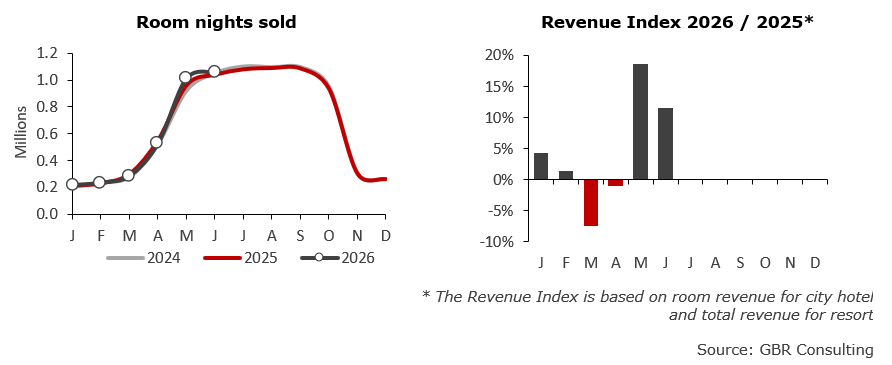
On the positive side, hotels have retained pricing power despite continued economic and geopolitical uncertainty. Stable occupancy indicates that the market has so far absorbed higher room rates without a material reduction in demand. However, with occupancy broadly stabilising, further revenue growth will increasingly depend on:
guests’ willingness and ability to pay;
a shift towards higher-spending customers;
constrained growth in competing accommodation supply;
continued airline capacity; and
the perceived value of the destination relative to other Mediterranean markets.
Stable occupancy may indicate either a healthy, mature market or the early stages of a pricing ceiling. There is not yet sufficient evidence to distinguish conclusively between these two interpretations.
In Athens, occupancy remained stable at 74.3% during H1 2026, while ADR increased by 6.9%. May was particularly strong in terms of room rates, supported by several large-scale events in the city.
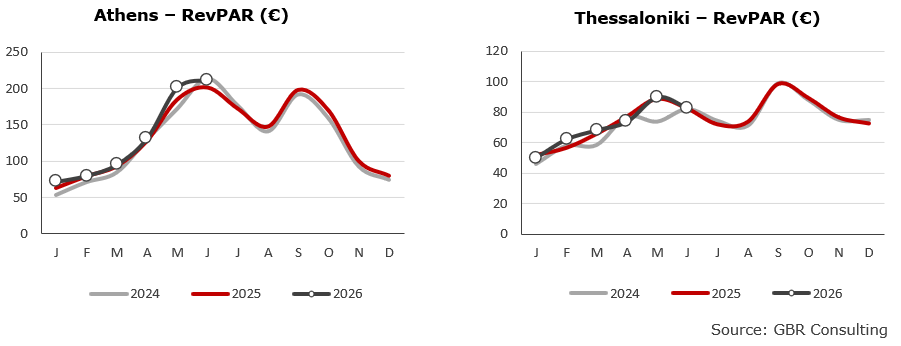
In Thessaloniki, occupancy declined by 2.6% during the first six months of 2026 compared with the same period of 2025. ADR increased by 3.3%, resulting in a marginal improvement in RevPAR.
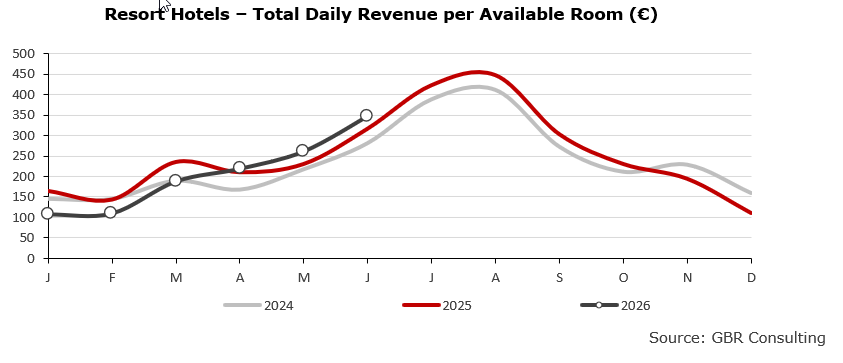
Relatively few resort hotels operate during the first quarter. During the second quarter, performance was mixed, with cumulative occupancy through June increasing by only 0.5% compared with the same period of 2025. Nevertheless, Total Daily Revenue per Available Room rose by 11.2%, again indicating that revenue growth was primarily price- rather than volume-led.
Inbound tourism growth is not translating proportionately into hotel demand
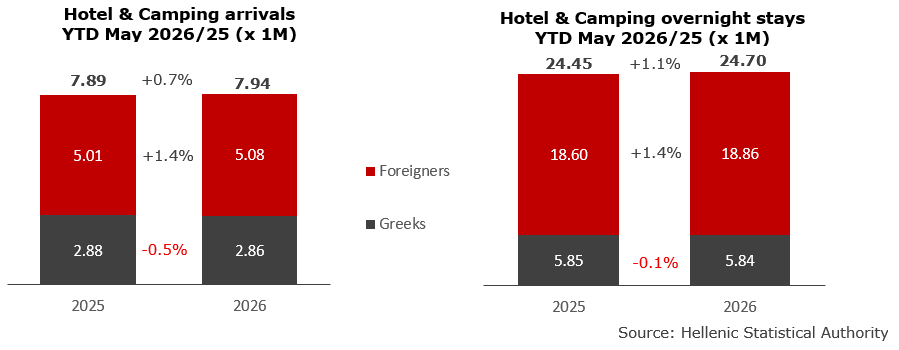
The stabilisation in hotel demand is also evident in data published by the Hellenic Statistical Authority for the first five months of 2026. Total arrivals at hotels and camping establishments increased by 0.7%, while overnight stays rose by 1.1%. Foreign demand performed somewhat better, with both arrivals and overnight stays increasing by approximately 1.4%. Domestic arrivals declined by 0.5%, while domestic overnight stays remained broadly unchanged. The monthly pattern was uneven, with weaker results in March and April followed by renewed growth in May.
The Bank of Greece presents a considerably stronger picture for inbound tourism overall. During January - May 2026, inbound traveller flows increased by 20.9%, while travel receipts rose by 25.8%. The increase in receipts reflected both a higher number of trips and a 4.5% rise in average expenditure per trip.
A significant part of the divergence appears to relate to the composition of inbound travel. According to the Bank of Greece, traveller flows through road border-crossing points increased by 64.5%. Such growth may include a comparatively high proportion of short visits, stays with friends or relatives, use of privately owned residences and accommodation outside the hotel and camping sector. Growth in short-term rentals may also have absorbed part of the additional demand. These factors could increase the number of inbound trips without producing a corresponding rise in arrivals and overnight stays at hotels and camping establishments.
The strong increase in travel receipts should not be interpreted as an equivalent increase in accommodation revenue. Bank of Greece receipts cover total visitor expenditure, including accommodation, food and beverage, transport, shopping and leisure activities. Inbound travel and overall visitor spending therefore expanded strongly, while growth recorded by hotels and camping establishments remained considerably more limited.
The balance of risks may be shifting
The more relevant external risk for Greek hotels arises less from domestic economic conditions and more from the effect of higher energy prices on Greece’s main source markets and on the cost of air travel. Germany is of particular concern: the Bundesbank expects the energy shock to weaken household purchasing power and slow the country’s still-fragile recovery. Although German arrivals to Greece increased during the first five months of 2026, receipts remained virtually unchanged, indicating materially lower expenditure per trip. The UK market has so far proved considerably more resilient, with strong growth in both travellers and receipts, although higher energy costs and a softer labour market may place greater pressure on household travel budgets later in the year
Recent economic data provide some reassurance, with euro-area GDP increasing by 0.4% in the second quarter and Germany recording growth of 0.2%. Nevertheless, the ECB’s latest survey of professional forecasters reduced expected euro-area growth for 2026 to only 0.6%, indicating that the underlying outlook for household income and consumer demand remains subdued.
Aviation represents a second and potentially more direct way in which higher energy prices could affect Greek tourism. Airlines and tour operators initially protected by fuel hedges and committed summer schedules have so far maintained capacity above last year’s levels. According to INSETE/OAG, scheduled inbound international airline capacity for the 2026 summer season was 7.6% above 2025. Air France–KLM had hedged 66% of its fuel consumption for 2026, while TUI had hedged 83% of its Summer 2026 requirements but only 62% for Winter 2026/27. Sustained jet-fuel prices could progressively feed into higher fares, weaker route profitability and more selective capacity decisions as hedges expire and airlines prepare future schedules. At the same time, the international shift towards shorter booking lead times is reducing forward visibility, even where final demand remains resilient.
Implications for Greek hotels and investors
Investor appetite remains supportive: CBRE’s 2026 European Hotel Investor Intentions Survey found that more than 90% of respondents planned to maintain or increase their hotel allocations.
For Greek hotels, the principal forward risk is therefore not necessarily an abrupt decline in travel demand, but may instead lie in a combination of greater price sensitivity, slower capacity growth and pressure on operating margins. These pressures could ease if geopolitical tensions subside and oil prices fall, although the effects on airfares and airline schedules would likely unwind only gradually. The inflation shock has also interrupted expectations of steadily declining financing costs: the ECB raised its deposit rate to 2.25% in June and kept it unchanged in July, warning that the full inflationary effects of the energy shock had yet to emerge. This environment favours prime city hotels and differentiated resorts with diversified source markets, strong air access, pricing power and effective cost control to convert revenue growth into sustainable operating profit.
“The Greek hotel investment market continues to benefit from resilient demand, continued revenue growth and sustained investor interest, as reflected in the transactions and strategic investments announced during 2026. Current external risks are more likely to influence asset selection, pricing and underwriting than to reverse investor appetite. Investors will therefore place greater weight on diversified demand, reliable air access and the ability to convert rate growth into sustainable NOI.”
Selected investment activity
In May 2026, Leonardo Hotels & Resorts Mediterranean, part of Israel’s Fattal Hotel Group, announced the acquisition of the 4-star Great Athens Hotel near Omonia Square, Athens. The hotel, which comprises 117 rooms, is currently operating as the Leonardo Hotel Athens City Center. While press reports refer to a total investment of approximately € 20 million, the acquisition price has not been disclosed separately.
At the end of June 2026, Hellenic Properties announced the acquisition of the Aristi Mountain Resort & Villas in Zagori, Epirus. The boutique 5-star resort comprises 26 rooms, suites and villas, together with restaurant, wellness and conference facilities. The acquisition price has not been disclosed. According to Hellenic Properties, the investment forms part of its strategy to expand its hospitality portfolio.
In June 2026, Premia Properties announced a strategic agreement with Akti Hotels & Resorts for an investment exceeding € 250 million in the hospitality sector. The proposed transaction concerns the Akti Imperial in Rhodes and the Akti Beach Club and Akti Palace in Kos, comprising a total of 1,316 rooms. The agreement provides for Premia to acquire an equity participation in the Akti Group and to finance the refurbishment and repositioning of the hotels, while Akti Hotels & Resorts will continue to operate the properties. The definitive transaction agreements are expected to be completed by the end of 2026.
Download in PDF format (253 kb)